Happy fall! In this newsletter:
- ISO new member of the BEES hive
- Upcoming events:
- Coffee + Invasives Removal @ Marigold + the Manhan Rail Trail
- Native Plant Seed Swap @ the Library Annex
- News and Resources
- Plant Profile: Calico aster
First things first: BEES is looking for a new member
Our current committee chair Sean will be taking a step back from the committee. We’re hoping to make it a smooth transition and find a new member to fill Sean’s seat. If you’ve ever thought about getting involved with this work, now might be a good time to try! The biggest thing the committee needs right now is someone with time to invest, so it’s ok if you’re learning as you go. The committee meets monthly, and members participate in the optional monthly coffee/invasives event and take on additional projects, such as event planning, research, advocacy, and public outreach, as they are able. Please reach out if you might be interested and we’d be happy to find a time to meet and discuss.
UPCOMING EVENTS
Coffee + Invasives Removal
As you likely know, we meet on the second Saturday of every month for coffee at Marigold Cafe at 9AM. We mosey over to the Manhan Bike Trail, near the Easthampton Feed Store at 10AM. The next gathering will be November 8. We hope you’ll join us! There’s still plenty of work to be done before winter.
Join the BEES Committee at the Library Annex for a native plant seed swap!

- Where: Easthampton Library Annex, 52 Main Street (map).
- When: Saturday, October 25, 2025, 10 AM – 12 PM
A great way to share native plants is to collect seeds at the end of the growing season and trade them with neighbors, so we can all grow more native species next year. A seed swap is a way to save money, find seeds you’ve been looking for, connect with others in our community who are growing native plants, and increase biodiversity by growing a wider variety of locally-adapted plant species. Whether you’ve been saving native seeds all year, or this is your first time growing native plants, join us at the Library Annex of October 25th! Register for the event here. PS: We will have plenty of extra seeds to share, so feel free to join us whether you have seeds to swap or not.
NEWS AND RESOURCES
- A group of Smith College students are working with DPW and the BEES Committee this fall to “develop an Urban Forest Plan that preserves and expands the tree canopy throughout Easthampton.” This exciting project will help us take action on Easthampton’s Climate Action Plan. We’re looking forward to working with the students, learning from their research, and sharing their results with you.
- Whether you’re planning to join us at the seed swap or not, check out our resource guide here with lots of information about how to collect native seeds, how to know what seeds are native, and the ethical and ecological guidelines to keep in mind. Happy collecting!
- Advocacy request: “Bees, butterflies, and other pollinators are disappearing at alarming rates—and neonicotinoid (“neonic”) pesticides are a key driver of these losses. A critical bill, H.1041/S.587 – the Pollinator Protection Act, will take a major step to safeguard pollinators in Massachusetts by phasing out crop seeds coated with neonics, one of the largest and most persistent sources of these insecticides. We plan to issue a letter in support as a committee. Learn more and submit an email to your legislators using the Xerces Society’s letter template. You can also call Sen. Velis and Rep. Gomez and ask them to support H.1041/S.587. (Information via the Xerces Society for Invertebrate Conservation)
PLANT PROFILE: Calico aster (Symphyotrichum lateriflorum)

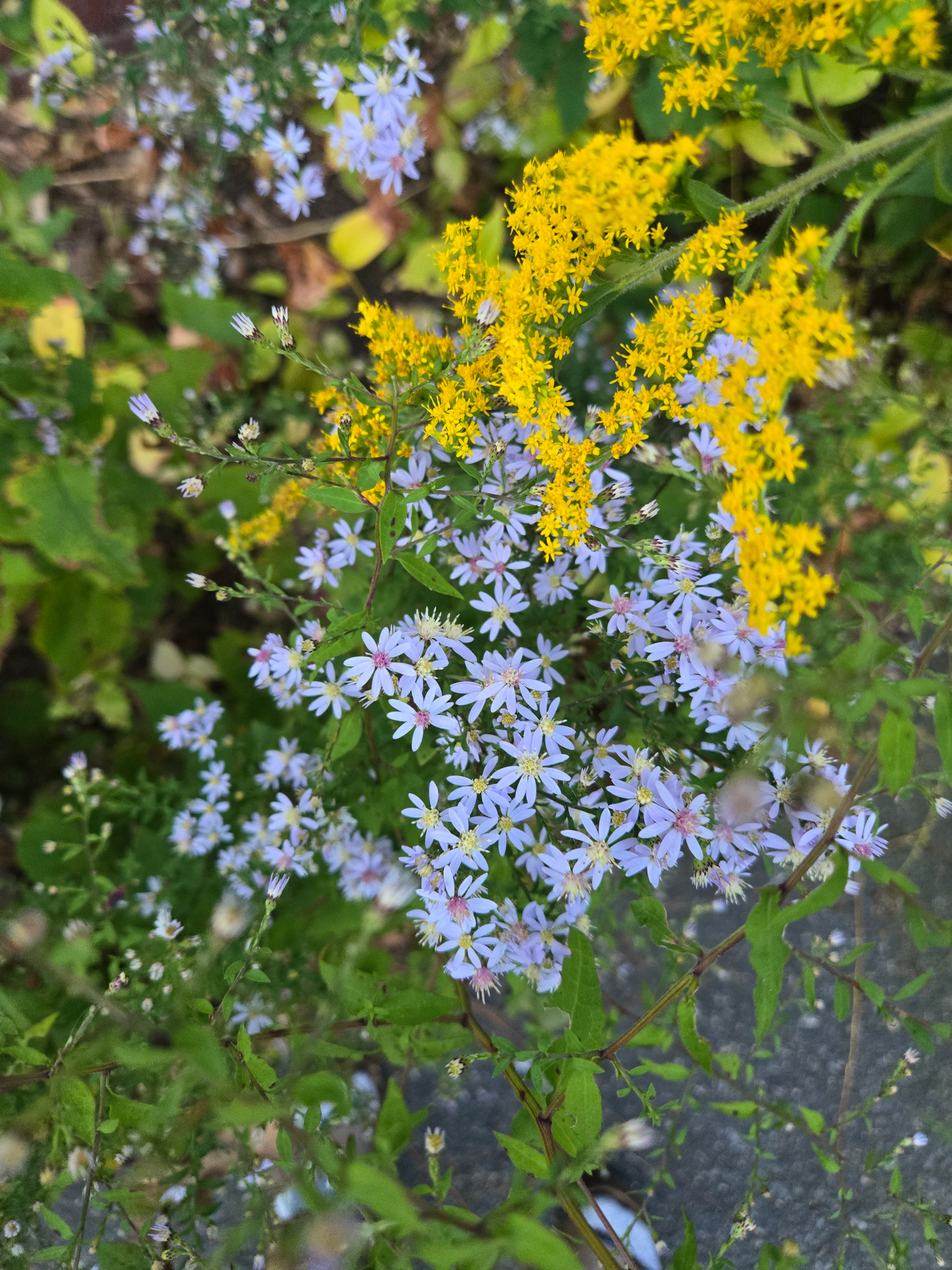
Did you know that asters are a keystone species? They host over 100 species of butterflies, the most of any flowering plant (outside of trees and shrubs). Nectar is an especially important resource in the late fall, when calico asters and showy goldenrod (at left) are among the few remaining sources of nectar available. (Revisit Robin Wall Kimmerer’s moving essay on why asters and goldenrod make a perfect pair.) While all asters provide invaluable resources to a huge range of pollinators, Calico asters are the only species of aster documented as a nectar source for Bombus terricola, one of Massachusetts’ native (and endangered) bumblebees. Calico asters are also distinctive for their exuberant mix of both yellow and purple disks on the same plant – hence the name. Beyond their ecological value, calico asters are long-lasting, versatile from sun to shade and moist to dry conditions, and their white flowers are a welcome addition to the fall garden, especially along shady understory edges.
Happy fall!
The BEES Committee (Sean, Renee, Hal, Jenny, Jamie and Koni)